Resource Review
bims: Biomed News
Farhad Shokraneh1
doi: http://dx.doi.org/10.5195/jmla.2026.2288
Volume 114, Number 1: 79-82
ABSTRACT
bims: Biomed News. February 5, 2017–Present. https://biomed.news/, Created by Thomas Krichel and directed by Gavin P. McStay. Free. Accessible via
any web browser.
DESCRIPTION
bims: Biomed News is a free weekly newsletter report creation system based on PubMed.
The newsletters contain selected recent PubMed records that pertain to the report's
topic. Therefore, bims can be categorized among the tools that provide Selective Dissemination
of Information (SDI).
USERS
bims community has two types of users: editors and readers. No criteria need to be
met to become a reader or an editor.
Editors select the papers for the weekly report issues. Most editors appear to be biomedical
researchers or systematic reviewers. Some are patients, staff, or patient support
organizations. This is typically the audience that health librarians serve. Therefore,
a review of this tool seems pertinent.
Readers can subscribe to weekly issues of any report. The reports are listed at https://biomed.news/reports. Each report has a “Sign Up” button. When you sign up, you get the weekly issues
of the report in your inbox.
COST
bims is an open and free tool with no monetary or non-monetary barrier to becoming
an editor, nor to becoming a reader.
HOW TO CREATE AND MAINTAIN A BIMS NEWSLETTER REPORT
Opening a new newsletter report. To become an editor, you need to open a report. This is done at https://biomed.news/open_a_report. This opens a simple form. It requires you to enter a title for the report, your
name, your email address, and at least one PubMed paper that you think is relevant.
Upon submission, the form data is sent to bims management. They create the report
and assign a six-character identifier. They then send you credentials. For example,
the author launched bims-arines (ARtificial INtelligence in Evidence Synthesis). Its first issue was released on
September 29, 2024.
Maintaining the newsletter report. When the report is opened, a weekly process starts. On Sunday at midnight UTC, you
get an email alert that a new report issue, containing a list of possibly relevant
new papers, is available for you to choose from. The new papers in PubMed are sorted
by the likelihood that they are relevant to your topic. You select the relevant ones.
The ones that you don't select are considered irrelevant. This data is fed into a
bespoke AI tool. Thus, each week's data is used to improve the new selections. Over
time, this leads to a selection of papers that is both more precise and more flexible
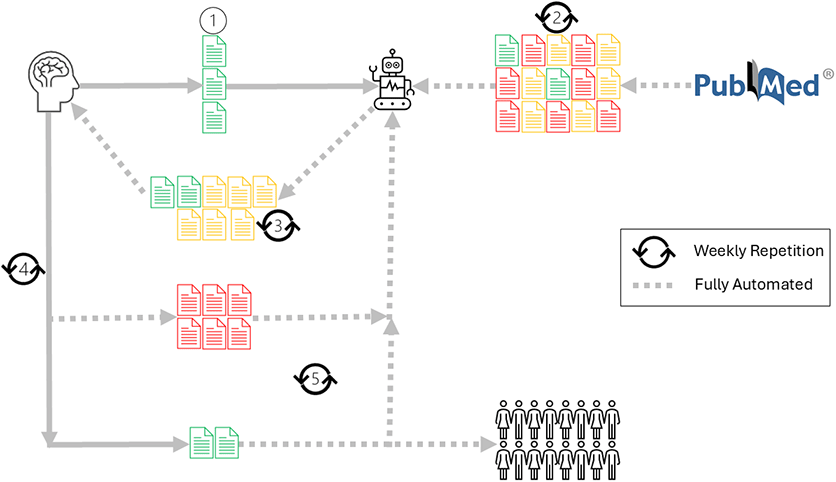
than the ones found by searching tools (Figure 1).
Figure 1
bims: Biomed News editors’ workflow.
1. Editor gives PMIDs of relevant records to bims. 2. bims automatically receives
weekly records from PubMed. 3. bims automatically selects the possibly relevant records,
sorts them based on relevancy, and sends them to the editor. 4. The editor selects
the relevant ones; the rest of the records are automatically considered irrelevant
and fed back to bims to improve its performance. 5. The relevant records are automatically
sent to the editor, the readers, and bims to improve its performance.
Output. The relevant records selected by the editor are sent to the subscribed readers in
the form of an email newsletter. The emails contain no advertisements. Each report
issue is also published on a dedicated web page. At the time of writing, the author
has published 44 weekly issues of bims-arines, reaching 83 subscribers. Every week, the author spends five minutes screening the
received records, selecting them, and submitting them, ensuring subscribers stay up
to date on the topic. The latest issues are found at http://biomed.news/bims-arines/latest.
HOW TO USE THE EXISTING BIMS NEWSLETTER REPORTS
Readers use the site: https://biomed.news/.
Cookies. The site does not request permission to use cookies. Presumably, the site does not
use cookies. It respects users’ privacy. This is an important issue for librarians
when recommending a tool.
User interface. The site does not use gratuitous graphics or meaningless marketese. Instead, the
homepage tries to convey the site's purpose through simple factual statements.
Newsletter reports. From the homepage, the most important link is the one to the reports, https://biomed.news/reports. The reports page lists all the active reports. Inactive reports can still be accessed.
Next to each report, there is the title of the report. The title is an anchor to the
latest issue of the report. Then, there is the editor's name. Usually, the name serves
as the link to the editor's homepage. After the name, for most editors, the editor's
affiliation appears, always with a link to the homepage of the organization, giving
credit to both the editors and their organization.
Sign Up. Readers can sign up for the reports on https://biomed.news/reports or each report's page (bims-arines). The editors cannot see the list of subscribers, which is another positive privacy
point.
Unsubscribe. Another user-friendly feature is that any report issue that readers receive includes
an unsubscribe link, both in the email header and at the end of the email body, making
it effortless to unsubscribe.
COMMUNITY BUILDING AND ENGAGEMENT
Timesaving through expertise-sharing. An expert can create a newsletter on a specific topic of interest, and community
members can subscribe to it, receiving updates every week. This way, rather than all
community members searching for papers on the topic, only one expert member spends
little time selecting the papers, and all community members benefit. Thus, bims is
an expertise-sharing system.
Crediting the editors. Many social media platforms prevent or discourage linking one's profile or affiliated
organization on the platform because such links direct readers away from the platform.
Social media platforms all try to keep users on the platform. bims management credits
the editors by mentioning their names and allowing them to link to their personal
profiles and affiliated organizations.
Free and open, shareable, and reusable reports. The readers can use the report issue data in any way they see fit. For example,
the weekly issue of the Biomed News report bims-librar on “Biomedical librarianship”
is distributed to the MEDLIB-L mailing list, a community of over 1000 members.
COMPARISON TO OTHER SDI SERVICES
While libraries and users have been utilizing binary SDI tools, such as email alerts
for saved searches, new articles, or journals’ table of contents, bims offers a unique
platform for leveraging machine learning to capture non-binary and fuzzy relevant
papers that would otherwise be missed in a search. The author has summarized the key
differences in Table 1.
Table 1
Comparing Selective Dissemination of Information (SDI) Methods
| Features \ Method |
Email Alerts or RSS |
bims |
| New Article |
Table of Contents |
Saved Boolean Search |
| Frequency |
ASAP |
ASAP |
Varies |
Weekly |
| Specificity |
✘ |
✘ |
✘/✔ |
✔ |
| Output selectivity |
✘ |
✘ |
✘/✔ |
✔ |
| Output relevancy |
✘/✔ |
✘/✔ |
✘/✔ |
✔ |
| Machine learning |
✘ |
✘ |
✘ |
✔ |
| Human-in-the-loop |
✘ |
✘ |
✘ |
✔ |
| Community service |
✘ |
✘ |
✘ |
✔ |
ADVANTAGES
Unprecedented performance. bims has incomparably better performance compared to saved Boolean search email
alerts. The author has set a saved Boolean search alert as well as a bims report on
the same topic. bims outperforms in finding unique, new, relevant records.
Users first. Not using cookies or advertisements, offering an easy ‘unsubscribe’ option, and
not sharing readers’ email addresses, even with the editors, demonstrate respect for
users’ privacy and preferences.
Expertise-saving. In any other SDI methods, the expertise put to sort records as relevant and irrelevant
at each email alert or RSS feed goes to waste. bims collects feedback from experts’
choices to improve its performance and save the editor's time in the next rankings.
Ease of use. Creating and maintaining the report, and subscribing and unsubscribing, are easy.
All technical and complex aspects are left behind the scenes. Shortcut keys enable
rapid movement across records for the editor without requiring the use of the mouse.
User support. bims management is directly and rapidly available via email. There are no chatbots
or layers of bureaucracy.
Potential use cases. While the focus of this review was on using bims to keep the community up to date,
it can also have other use cases, such as focusing on machine learning, including
systematic review updates.
LIMITATIONS
Search facility. bims lacks a search feature to locate and retrieve records on its website.
Source of data. Currently, PubMed is the only source of records for bims; however, the name ‘Biomed
News’ suggests its possible generalizability to other accessible sources.
Dependency on editors. bims is not a regimented service. Editors can produce report issues at their leisure.
Some may be very punctual, and others less so. Thus, subject report issues may appear
at irregular intervals. Although it has been functioning well since 2017, community
editors are crucial to the creation and maintenance of the reports. Reports can become
inactive if the volunteer editor decides not to select the relevant records every
week.
Long-term interest. Creating newsletter reports is suitable only for topics with long-term interest,
where the editor is willing to invest a few minutes of their time per week in the
topic.
Subject coverage. Uptake of bims varies across subject areas of PubMed. Some readers may not find
a report on their topic of interest to sign up for.
Quality control. There is no quality control over the editors. A report can be created by anyone,
including those who are completely unfamiliar with the topic. However, since maintenance
of a report requires weekly action, the author presumes that inept editors would drop
out quite soon.
Specificity. bims, as an SDI tool, may be unsuitable for broad topics (e.g., stroke, cancer);
however, it works best with more specific topics and serves as a complementary tool
to the existing Current Awareness Services (CAS) in libraries.
Lack of email confirmation. Upon signing up, users do not receive a confirmation email to verify their address.
Thus, if you enter an invalid address, you will not see any report issues.
CONCLUSION
bims is one of the rare modern and AI-based tools that advocates all Ranganathan's
five laws of library science, making records usable, referring right records to the
right readers, saving readers' and editors’ time, and saving the expert knowledge
through feedback to the bims machine learning feature, improving its performance as
an evolving and growing organism.
With knowledge of its use, advantages, and limitations, library and information science
professionals can introduce bims to expert potential editors and readers with no concerns
about the commercial use of their data or privacy issues.
© 2026 Farhad Shokraneh
This work is licensed under a Creative Commons Attribution 4.0 International License.
Journal of the Medical Library Association, VOLUME 114, NUMBER 1, January 2026